Transforming Complex Logistics Into an Intelligent System
Leading the transformation of complex enterprise billing workflows into intelligent, scalable product capabilities, starting with Metapack and establishing a foundation for expansion across ShipStation Global’s portfolio of nine brands.
Product design leadership focused on product strategy, experience design, and technical implementation in partnership with a globally distributed, cross-functional team.
| Overview | |
|---|---|
| Company | ShipStation Global |
| Business Model | Enterprise B2B SaaS & Fintech |
| Focus | Product Innovation, Enterprise Automation, Platform Scalability, AI Integration | Role | Product Lead |
| Responsibilities | Cross-Functional Leadership, Product Strategy, Customer Research, Systems Architecture, Design System Expansion, AI Strategy, New Product Development |
| Partners | Enterprise Customers, Global Product & Engineering Teams, Executive Stakeholders |
| Results | Established a scalable product offering across nine brands, targeting 90% time savings, 2–5% shipping cost savings, and up to $2.9M in incremental ARR. |
-
9 Brands
Intended Portfolio Reach
-
187 Enterprise Retailers
Initial Addressable Customer Base
-
90% Time Savings
Targeted Reduction in Manual Reconciliation

The ChallengeOperational Complexity at Enterprise Scale
Enterprise retailers and third-party logistics providers relied on fragmented systems and labor-intensive processes to reconcile shipping costs across multiple carriers. Complex contractual rates, inconsistent invoice formats, and billing discrepancies created operational inefficiencies, financial leakage, and barriers to scale.
Carrier Contracts
Rates & Surcharges
Shipment Data
Warehouse & Delivery
Carrier Invoices
Billing & Charges

Logistics Operations Manager
Manual Invoice Reconciliation
Spreadsheets · Line-by-Line Validation · Discrepancy Review
Carrier Disputes
Email & Claims
Finance Handoff
ERP & Accounting
Reporting
Manual Analysis
Financial Leakage
Operational Inefficiency
Limited Scalability

Insights & StrategyDesigning for Complexity, Building for Scale
We began by serving the most complex enterprise shipping segment.
Through customer research, workflow mapping, and iterative validation, I led the translation of complex business processes into reusable product capabilities.
By expanding the ShipStation Global design system, we accommodated operational complexity with visual language and information architecture that could seamlessly scale.
Key Pain Points
Finding 01
Complex Carrier Contracts
Lengthy rate cards, changing contractual terms, and inconsistent surcharges made accurate validation difficult.
Product Response
Simplify Rate Card Management
Translate complex carrier contracts into structured, versioned, and reusable digital rate models.
Finding 02
Manual Validation Created Bottlenecks
Teams reviewed individual transactions across spreadsheets and disconnected operational systems.
Product Response
Automate Invoice Reconciliation
Automate transaction matching and surface discrepancies that require human intervention.
Finding 03
Rigid Approval Processes Delayed Resolution
Individual billing discrepancies could trigger full invoice rejections and lengthy carrier communications.
Product Response
Enable Configurable Exception Management
Introduce thresholds, approval rules, and issue-level resolution to reduce unnecessary manual review.
Finding 04
Disconnected Financial Workflows
Validated invoices required additional manual preparation before being transferred to Finance.
Product Response
Connect Operations and Finance
Create actionable invoice summaries, financial exports, and clear payment determinations.
Product Strategy
Reusable Product Capabilities
Auctane Design System
Shared Components · Interaction Patterns · Scalable Workflows
01
02
03
04
05
06
07
08
09
Extend Capabilities Across Portfolio of Nine Brands
Adapting capabilities to different tiers operational scale.
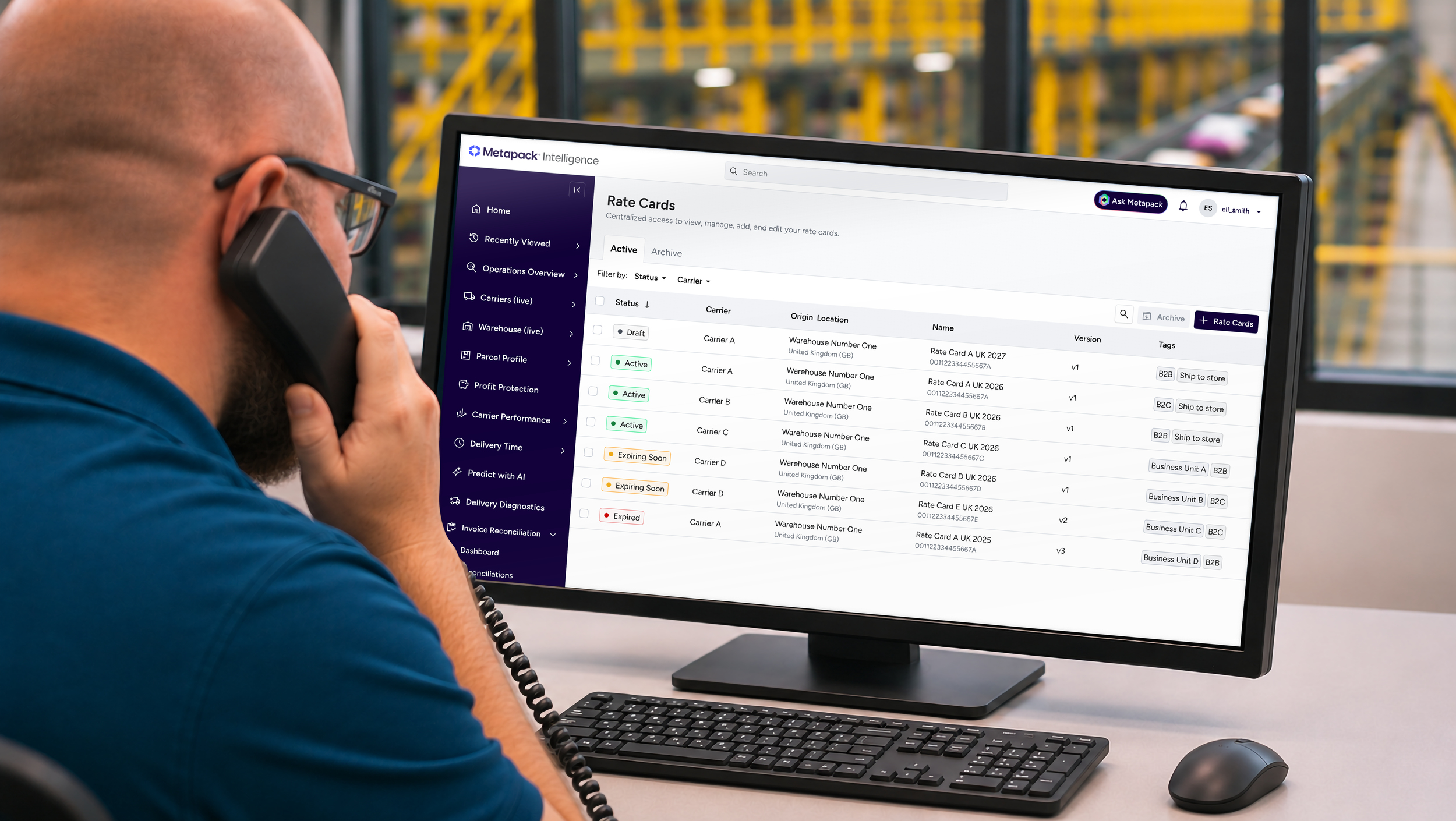
Designing an Intelligent System
I led the definition of an end-to-end reconciliation system that connected operational data, configurable business logic, automated workflows, and human-in-the-loop decision making.
Establishing a shared architecture enables product capabilities to scale across carriers, customer segments, and portfolio brands.
1. System Configuration
Origin Locations
Accounts & Depots
Rate Cards
Rates & Surcharges
Automation Rules
Conditions & Actions
Invoice Templates
Data Mapping
2. Invoice Ingestion
Invoice Upload
Bulk File Import
Data Mapping
Field Standardization
Origin Resolution
Account & Depot Matching
MCP Integration
Intelligent Invoice & Shipment Data Retrieval
3. Automated Reconciliation
Transaction Matching
Deviation Detection
Automation Rules
Shipment Event Validation
Service Failure Detection
Carrier Credit Identification
Intelligent Anomaly Detection
Reconciliation Outcomes
Ready for Sign Off
All Charges Validated or Approved
Action Required
Unresolved Deviations
Failed
Import or Matching Error
Sign Off
Review & Approve
Confirm Reconciliation Results
Manual Intervention
Review & Resolve
Resolve Exceptions
Investigate
Correct & Rerun
4. Final Determination
5. Downstream Workflows
Carrier Claims
Dispute Resolution
Finance Handoff
Structured Exports
Operational Intelligence
Reporting & Analytics
Shared Platform Infrastructure
Version Control · Audit Trails · Account Settings · ShipStation Global Design System
Key Design Decisions
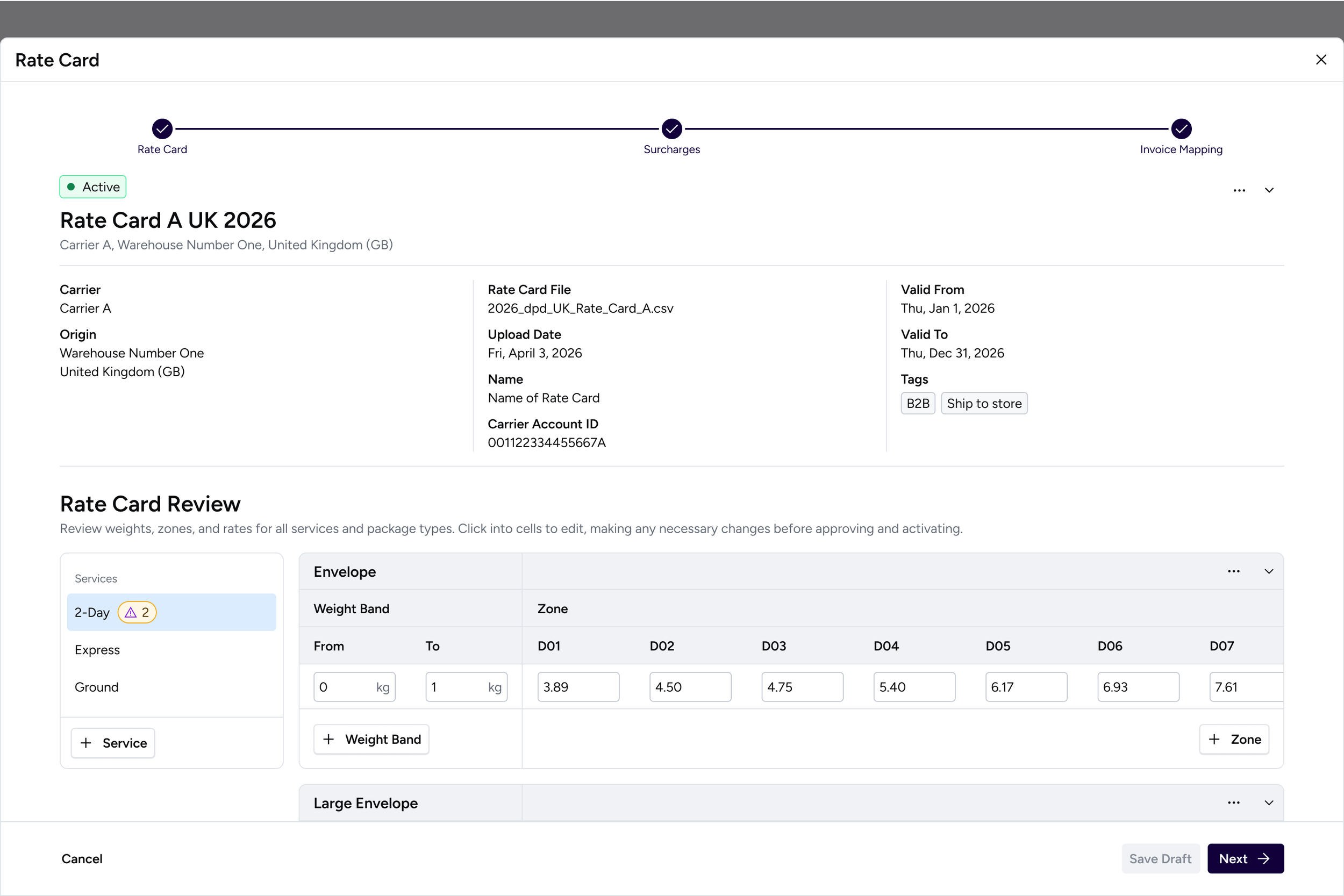
Establishing the Data Foundation for Automation
Accurate automation requires reliable, structured data.
By translating complex carrier contracts into standardized, versioned rate models, we establish a reusable foundation for reconciliation and dispute resolution.
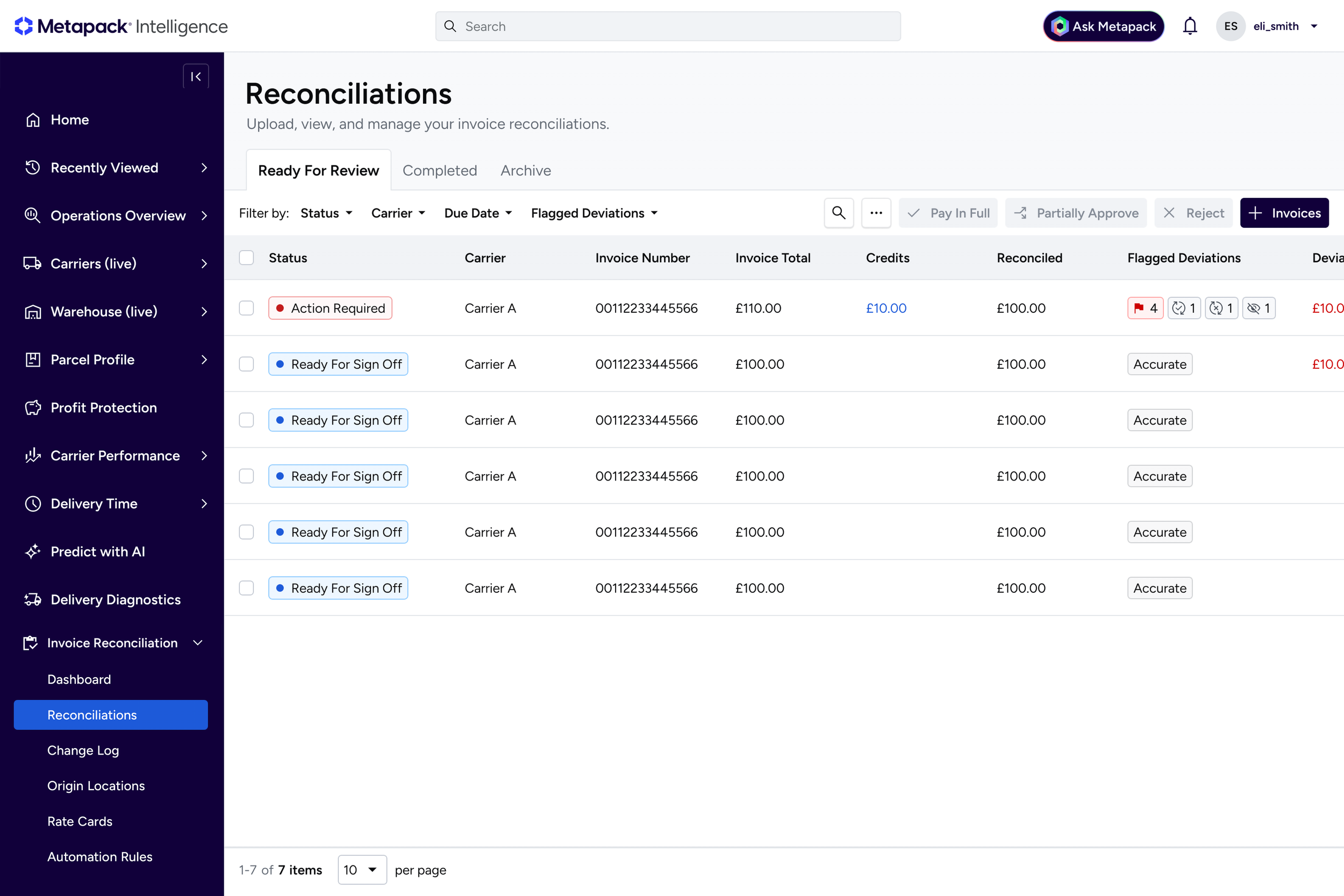
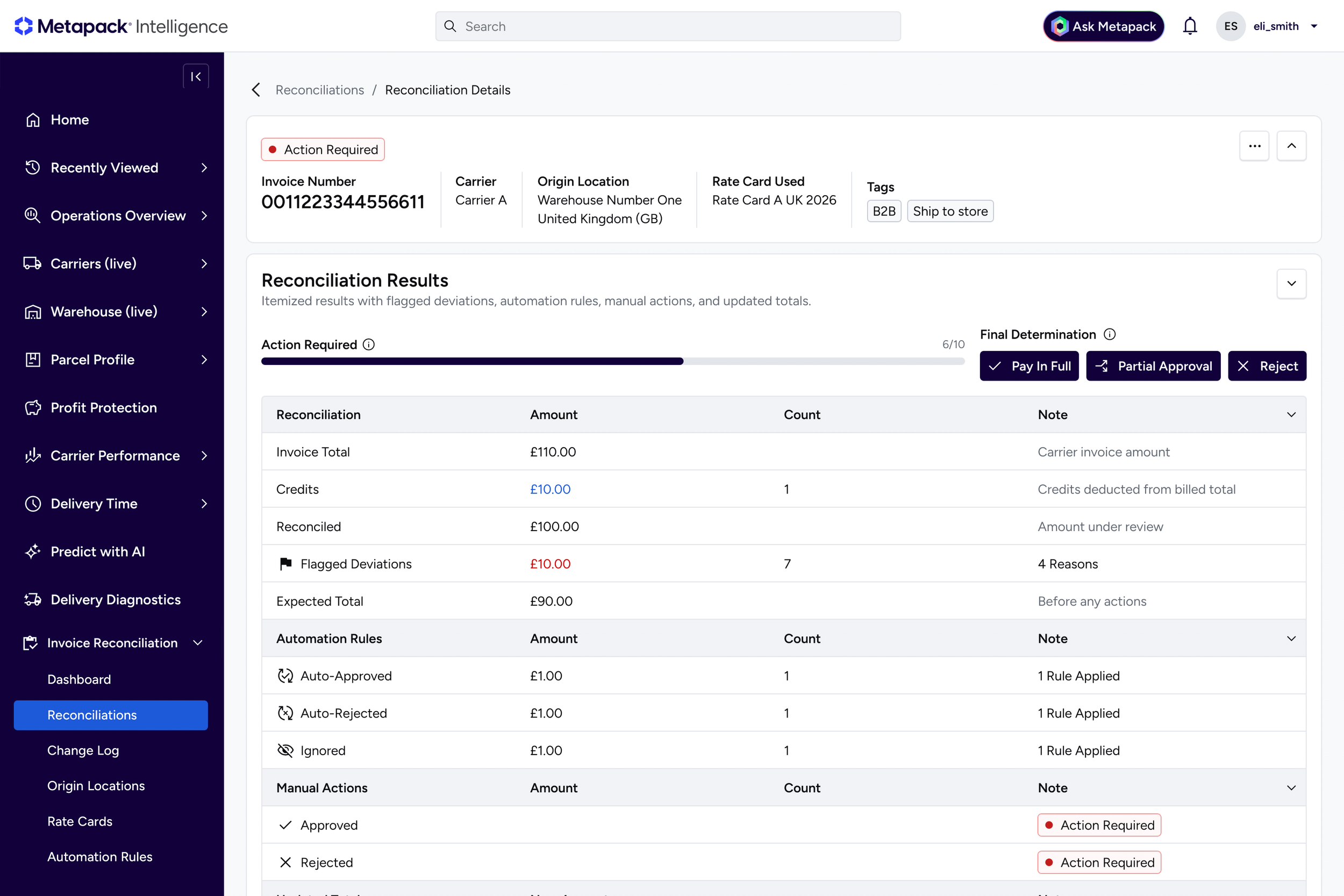
Shifting From Manual Validation to Exception Management
Rather than digitizing an inefficient manual process, we redesigned workflows around exception management.
Configurable automation rules validate charges against contracted rates and resolve deviations within established thresholds, allowing teams to focus on exceptions that require human judgment.
Connecting Operational Workflows to Financial Intelligence
Aggregating reconciliation data provides customers with greater visibility into shipping expenditures, recurring billing discrepancies, and carrier performance, enabling them to identify cost-saving opportunities, negotiate more favorable contracts, and optimize carrier selection.
Intelligent Automation Architecture
Connected Data
Model Context Protocol
Invoice & Shipment Retrieval
Carrier & Contract Data
Connected Operational Systems
AI Assistance
Contextual Intelligence
Pattern Recognition
Contextual Recommendations
Predictive Insights
Human Oversight
Operational Governance
Rule Approval
Exception Resolution
Financial Determinations
Automated Reconciliation Engine
Deterministic Business Logic · Configurable Rules · Auditable Actions
Intelligent Assistance with Human Accountability
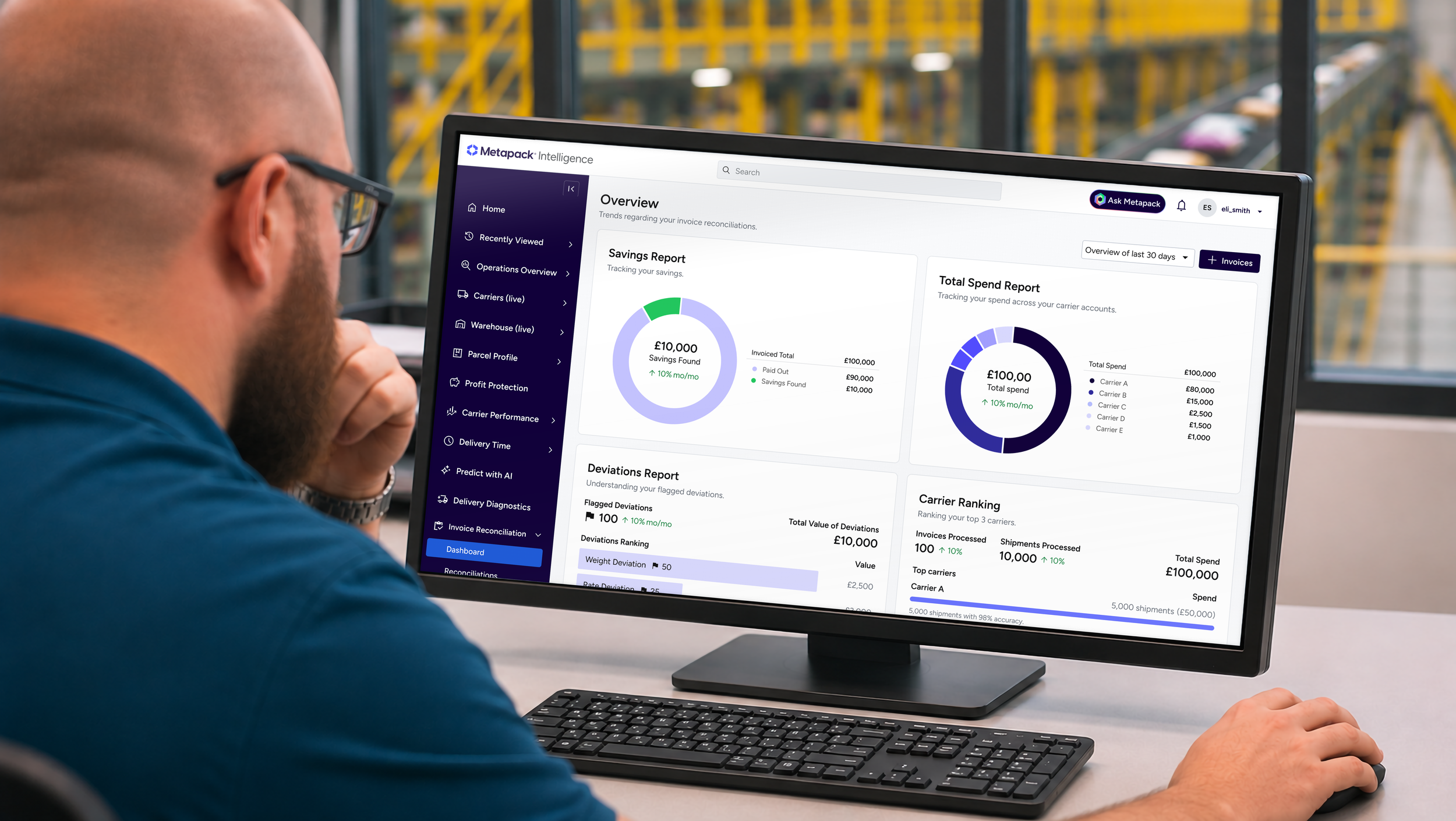
Designing for Intelligent Automation
The reconciliation engine establishes a foundation for extending rule-based automation into AI-assisted workflows.
AI assistants extract contractual data, detect anomalies, and recommend actions, while Model Context Protocol (MCP) enables them to coordinate workflows and execute authorized actions across connected platforms.
Human approval governs critical financial decisions, while centralized audit trails maintain a record of all actions for financial accountability.
Connected Operational Ecosystem
AI Chat
Conversational Interface
MCP-Enabled Orchestration
Connected Data · Tool Access · Authorized Actions
Claude
Contract Extraction & Rule Configuration
Gmail
Invoice Retrieval & Notifications
Metapack
Reconciliation & Payment Determinations
Carrier Systems
Payment Coordination & Claims
Centralized Activity Log
Action Attribution · Transaction History · Financial Audit Trail
Increased Automation with Operational Accountability
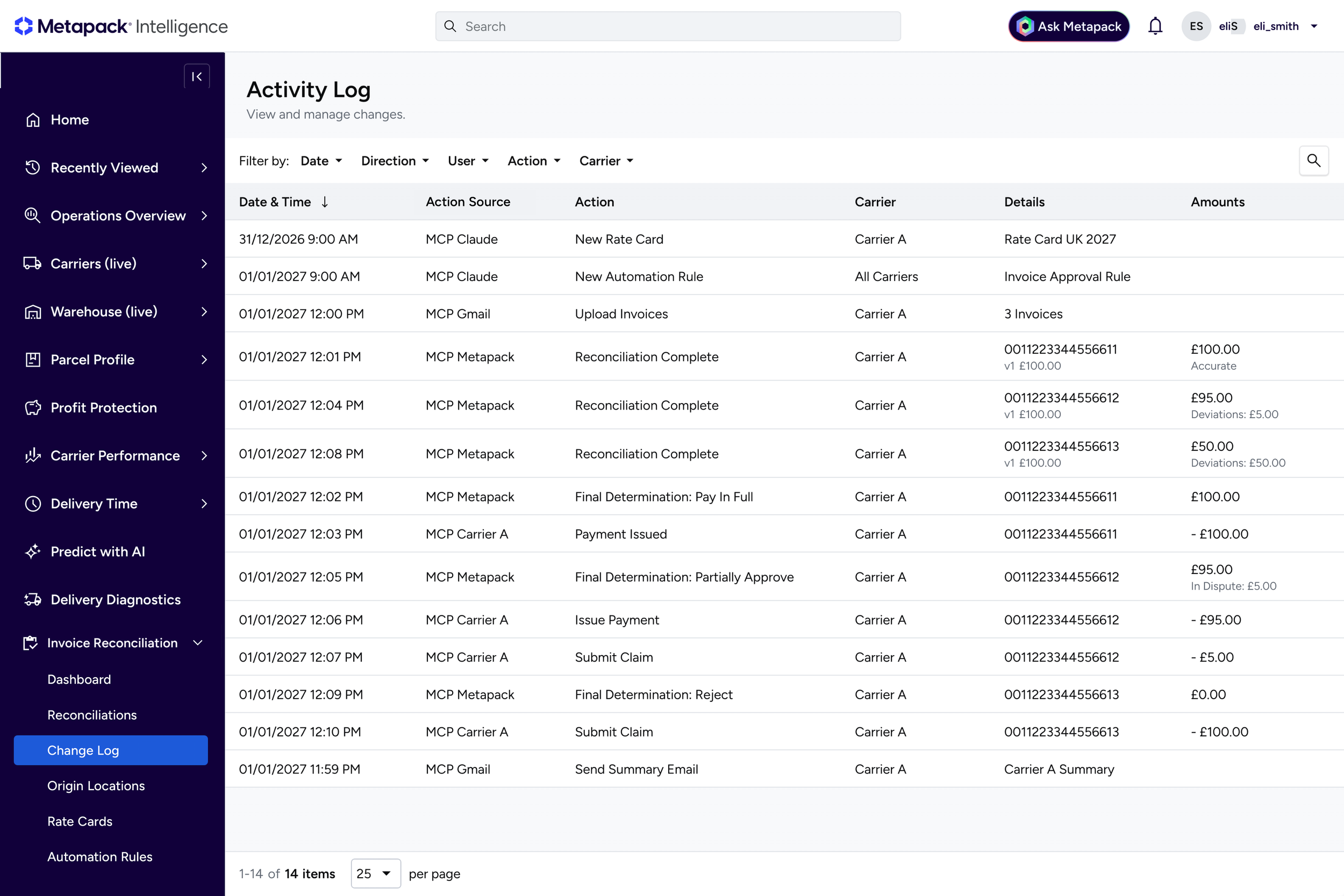
MCP-Enabled Workflow Orchestration
Through Model Context Protocol (MCP), AI assistants can interact with connected operational systems to orchestrate workflows.
MCP enables cross-platform coordination while maintaining human oversight within established business rules using a centralized record of human, automated, and AI-assisted actions for financial accountability.

✅
Results
Establishing reusable product capabilities designed to scale across nine brands. Creating a new fintech offering with the potential to generate $2.9M in incremental ARR.
-
90% Increase in Operational Efficiency
Targeted reduction in manual reconciliation time
-
2–5% Cost Savings
Targeted reduction in shipping costs
-
Multi-Carrier Scalability
Support expansion without proportional headcount growth
Projected Revenue Diversification
Existing Revenue Mix
First-Year Projection
Long-Term Upside
First-Year ARR Opportunity
$233K–$583K
Potential ARR Upside
$1.2M–$2.9M